
Article
The Global Circular Economy: A Sustainable Future
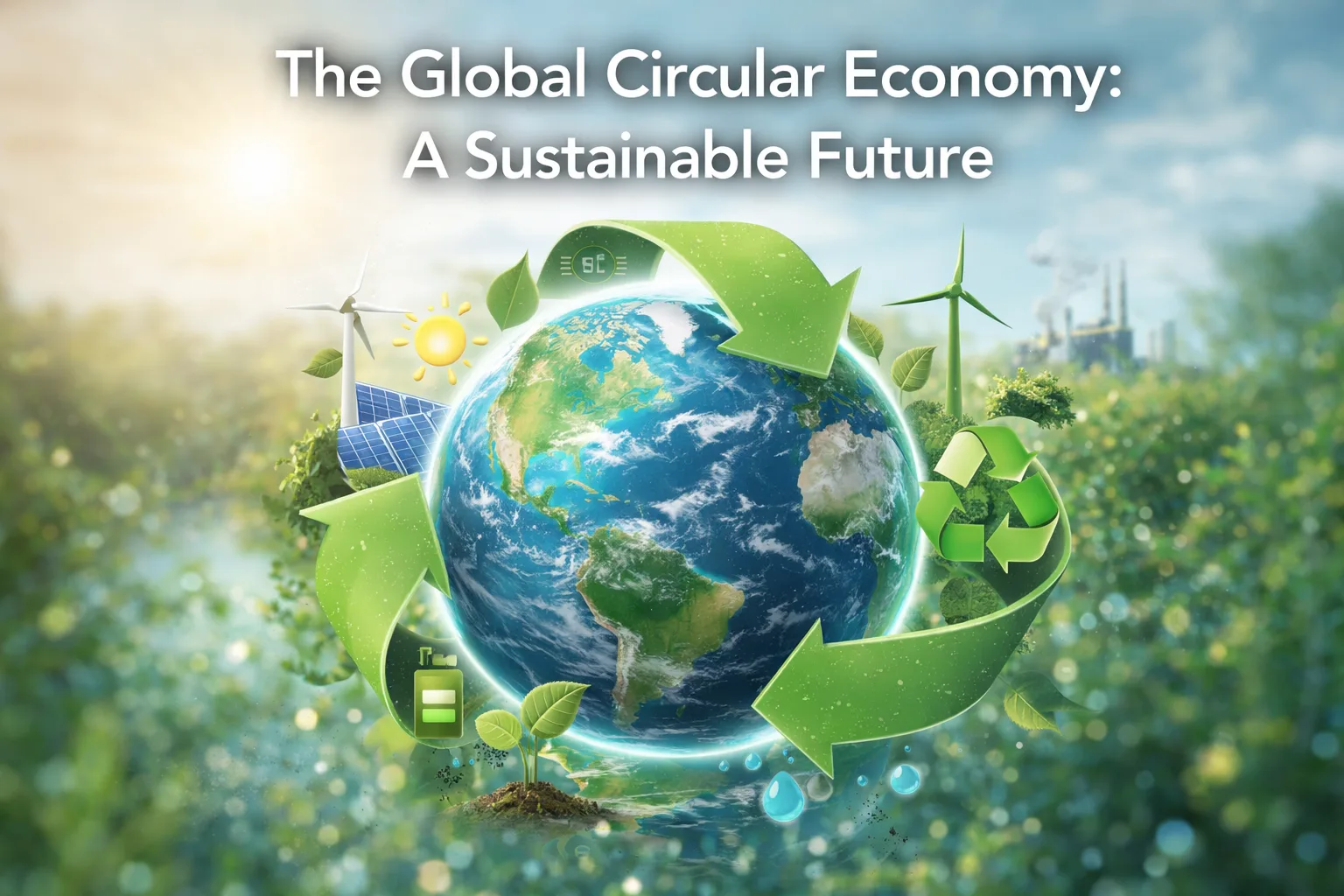
The principles, benefits, and challenges of a circular economic model
Introduction
The concept of a circular economy represents a transformative approach to economic development that benefits businesses, society, and the environment. Unlike the traditional linear economy, which operates on a ‘take-make-dispose’ model, a circular economy is regenerative by design and aims to decouple economic growth from the consumption of finite resources. Through principles of closed-loop systems, reuse, repair, refurbishment, and recycling, the circular economy seeks to minimize waste, reduce resource use, and foster sustainable development on a global scale.
Principles of a Circular Economy
A circular economy is built upon three fundamental principles:
1. Design Out Waste and Pollution
At the core of the circular economy is the idea that waste and pollution are not inevitable byproducts of economic activity but can be designed out of the system. This involves rethinking product design, production processes, and material choices to eliminate waste at the source. For instance, products can be designed for longevity, modularity, and ease of disassembly, ensuring that materials can be reused or recycled at the end of their life cycle.
2. Keep Products and Materials in Use
Maximizing the utility and value of products and materials for as long as possible is another key principle of the circular economy. This can be achieved through strategies such as maintaining, repairing, and upgrading products, as well as promoting sharing and leasing models. By extending the lifespan of products and keeping materials in continuous circulation, the demand for virgin resources is reduced, and environmental impacts are mitigated.
3. Regenerate Natural Systems
A circular economy seeks to not only reduce harm but also to actively improve and regenerate natural systems. This involves using renewable energy sources, promoting biodiversity, and enhancing ecosystem services. Biological materials, such as food waste, can be composted and returned to the soil, contributing to soil health and carbon sequestration.
Benefits of a Circular Economy
The transition to a circular economy offers a wide range of benefits for the environment, businesses, and society as a whole:
1. Environmental Benefits
By reducing waste and conserving resources, a circular economy significantly lowers environmental impact. It reduces greenhouse gas emissions, decreases pollution, and minimizes the extraction of raw materials, which often leads to habitat destruction and biodiversity loss. Furthermore, the focus on regenerating natural systems supports the restoration of ecosystems and enhances resilience to climate change.
2. Economic Benefits
The circular economy presents new business opportunities and economic growth potential. Companies can achieve cost savings through efficient resource use and waste reduction. The creation of new markets for recycled materials, remanufactured products, and circular services stimulates innovation and entrepreneurship. Additionally, the circular economy can foster job creation in areas such as product design, maintenance, recycling, and renewable energy.
3. Social Benefits
The circular economy contributes to social well-being by promoting sustainable consumption and production patterns. It can enhance community resilience by reducing dependency on finite resources and increasing local production and recycling capabilities. Moreover, the emphasis on sharing and collaborative consumption fosters stronger community ties and promotes equitable access to goods and services.
Challenges and Barriers to Implementation
While the benefits of a circular economy are clear, its implementation faces several challenges and barriers that need to be addressed:
1. Technological and Infrastructural Challenges
Transitioning to a circular economy requires significant technological advancements and infrastructural changes. Developing efficient recycling technologies, designing products for circularity, and establishing reverse logistics systems are complex and resource-intensive tasks. Investments in research, development, and infrastructure are necessary to overcome these challenges.
2. Economic and Financial Barriers
The shift to a circular economy may involve substantial upfront costs for businesses, such as investing in new technologies, redesigning products, and establishing circular supply chains. Access to financing and incentives can be limited, especially for small and medium-sized enterprises. Policymakers need to create supportive frameworks, such as tax incentives, subsidies, and grants, to facilitate the transition.
3. Regulatory and Policy Barriers
Existing regulations and policies often favor linear economic practices and can hinder the adoption of circular models. Regulatory frameworks need to be updated to promote circular economy principles, such as extended producer responsibility, product standards, and waste management regulations. International cooperation and harmonization of standards are also crucial to address global supply chains and promote circularity across borders.
4. Cultural and Behavioral Barriers
Achieving a circular economy requires a fundamental shift in consumer and business mindsets. The linear ‘take-make-dispose’ mentality is deeply ingrained, and changing consumption patterns and business models can be challenging. Education and awareness campaigns are essential to promote the benefits of circular practices and encourage behavioral change among consumers and businesses.
Conclusion
The global circular economy offers a compelling vision for a sustainable and prosperous future. By designing out waste and pollution, keeping products and materials in use, and regenerating natural systems, the circular economy provides a comprehensive framework to address the environmental, economic, and social challenges of our time. While the transition to a circular economy is complex and requires concerted efforts from all stakeholders, the potential benefits are immense. Through innovation, collaboration, and supportive policies, we can accelerate the shift towards a circular economy and create a resilient, inclusive, and sustainable world for future generations.